Showing posts with label coding dojo. Show all posts

Sunday, November 22, 2009

Agile 2009 - Day 3 - 26th August - Kake Coding Dojo

On Wednesday evening, after the talks were over, I organized a Kake Coding Dojo at the open jam area. We had 3 computers (my own running OS X, Thiago Colucci's with Ubuntu Linux and Pedro Leal's one with OS X) and about 10 people participating.
We chose Kata Bowling as our problem.

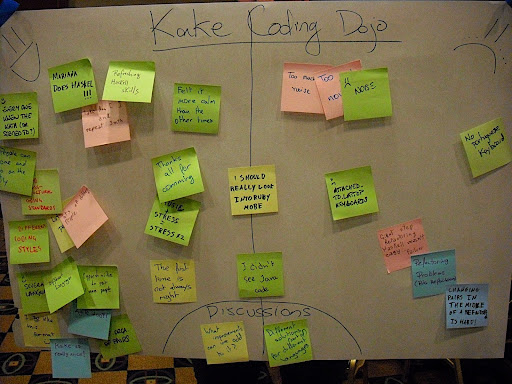
We built up the nice sheet you can see above (thanks Danilo Sato for the picture) with our explanation of the problem as well as the mechanics. This way, we intend to get people to join us on the fly while the dojo was already running. And it worked! We had about 3 or 4 people that came by, joined for two rounds and then left. A few people kept around just chatting about what was going on and wondering how to things were going. Thanks Pedro Leal for the picture below.
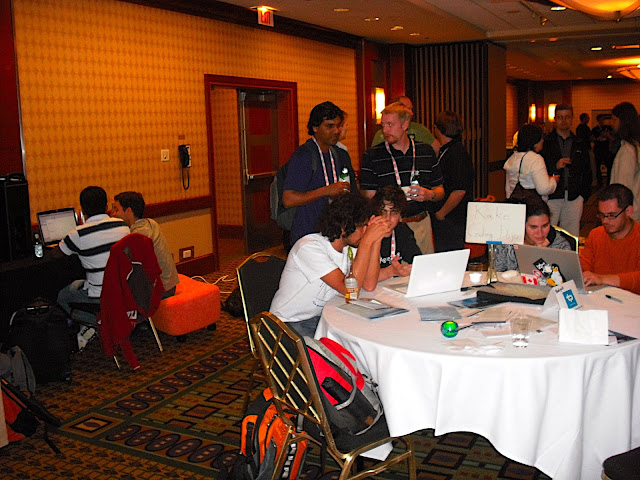
The same problem was being solved in Ruby, Haskell and Java on each computer and it worked about fairly well in all of them. We kept 7 minutes round as usual and just had some problems with missing experts on Haskell (just two people very familiar with the language and 2 more with some experience) which drove us to ask out for help to other Agile attendees.
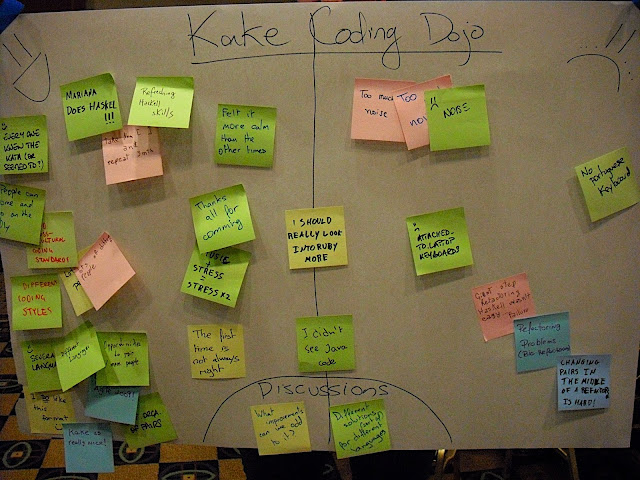
Finally, we ran our retrospective which the result you can check on the picture above (or this link for the higher resolution one).

Our main problems were about the noise around (downside of being in an open area) and our lack of detached keyboards (which could have jumped from hand to hand more easily). We learned (the hard way) that changing a pair in the middle of a big refactoring is really hard. It is very difficult to explain what is happening to the newcomer when the code is not working.

People also liked trying Ruby and Haskell but mostly the experience of pair programming with different people from different backgrounds. There was a small issue regarding the stress situation that the format puts participants on. 7 minutes is a short time and having the pressure to explain the code to the newcomer and adding your own contribution in that time (not being able to fail on any or else the whole code might get lost) is not an easy and comfortable situation. From this view point, the format breaks the safety aspect so important in a Coding Dojo. On the other hand it also leads to a more exciting experience and gets you to practice a different set of skills.

On the overall it was an amazing experience and I would like to thank everyone for joining us. After so much fun, we obviously went out for some dinner at an amazing burger place in Chicago.


You can checkout the generated code of the three solutions at Coding Dojo São Paulo's github account. There are also more pictures from Danilo at his Flickr account and some more from Pedro at his Picasa account.

Monday, October 27, 2008

Tuesday at OOPSLA'08

Tuesday I managed to seen a bit less things from the conference since I had to work as part of my student volunteer program for most of the day. I managed to see the opening keynote and at the end of the day, have a session of traditional Coding Dojo.

The opening keynote was from an archeologist named Mark Lehner who dedicated over 30 years of his life to the history of Egypt. He had a long talk about the way the pyramids are viewed and his search for the city that existed to support the pyramids constructions. Aside from several very interesting information about archeology and the way archeologists work, his talk showed how modular the city that built the pyramids was. Amazingly, the houses of the workers were all pretty much the same several times replicated as instances of a model. He also showed that the hierarquical structure among the builders was the same as in every social organization where roles were different acording to the structure where you were, or simply polymorphic.

All this is interesting and shows the ideas we have nowadays are not even close to be new and have been used over and over. Reassuring but no big deal to me. What amazed me was that those things only happend in the city that built the pyramids and the people in it. The pyramids themselves not modular or polymorphic at all. They are carefully hand crafted to and not slightly modular. I don't know yet what to take away from this information but it sure sounds like something we should think about.

During the day I did a few volunteers task. I ended my day by attending to the Coding Dojo session. First of all, I wish people with the Javascript library called 'dojo' would rename their project to something more appropriate. According to their own website, 'dojo' is just a name that won't get them sued. Coding Dojos actually do have a reason to be called as such and I had a few people coming over thinking we were going to talk about the library which is somehow anoying. Anyway, we had a small group (4 people including me and Mariana) and we attacked the Minesweeper problem in Java. We managed to code a solution but we were not really very pleased with it at the end. Mostly because we only had two tests (although we had a 100% coverage) and we took some very big steps during the solution. This is a very common outcome for a first session of a Coding Dojo. Feeling which tests will result in a major step is something that does not have (yet?) a Shu or Ha description and is usually learned with practice and time.

That's about it for Tuesdays. I'll post a bit about the following days later on this week.
Enjoy yourselves.

Empty open spaces at OOPSLA'08

Hi again,
I spent most of Monday afternoon at the Open Space area at OOPSLA. Open spaces are a very interesting concept to get people gather around a subject. It is based on the fact that it is much more useful to have a conversation than a monologue. Therefore, traditional presentations are less useful than getting people together to chat with each other.

So what you need to have an open space?
Well, space, a big board, a few tables, a lot of chairs, flip charts and, maybe, just maybe, one projector. On the big board, write down a time schedule with several areas available (places with chairs and a table) and provide a way for people to suggest their topics.
After that, you need to warn people about a few things. There are 4 rules on open spaces and one law. The rules are:
  1. It starts when it starts
    This means that people can be late, people can just post and sit and start talking or people can start it before or after the time schedule.
  2. Those who attend are the right persons
    Whoever comes in is welcome and should be there. No matter if that person does not know much about the subject or is an expert. A lot of very interesting things can be achieved by just gathering people that know very little about a subject but are willing to spend some time thinking about it.
  3. Whatever happens was the only thing that could have happened
    If the output of the meeting is that this subject is useless to be discussed, so be it. It is still a very good thing to learn. If, on the other hand, you decide that the people there are more interested in something else and you change themes, great too!
  4. It ends when it ends
    There is no need to speed or slow people to finish on schedule. If the subject has not been fully discussed, stay. If it has, go. Nothing to worry about.
The law is called "The law of 2 feet" or "The law of mobility". It states that if you are not giving to or receiving from anything of that open space session, then leave. It is understood and expected that people only stay if they are passionate about what is being discussed. This allows people to leave a group freely at anytime therefore keeping the group always happy about the ongoing discussion. The two feet come from a foot of passion and one from responsibility which should allow you to leave if needed.

This also allows for two specific behaviors. The first one is the butterfly one which consist of flying around the spaces just to check what is going on without participating actively or staying anywhere. Those can generate new subjects when meeting another of their species. The second one are the bumble bees. Those go around each conversation and sit for a while, engage in the discussion and then leave to another area. Those ones allow for information and different perspectives to flow across the areas. Both should be welcome and accepted in an open space environment.

This was the first year OOPSLA had an open space are. Dirk Reihle was responsible for that but, sadly, he got stuck in Germany trying to get his work visa to the US. Luckily enough, Deborah Hartmann was there to replace him. Since OOPSLA's open activities really only start on Tuesday, the area was quite empty on Monday afternoon and the Coding Dojo session I had suggested with Mariana ended up empty. We then decided to help Deborah in creating an interactive poster to present the Open Space during the poster presentations at the ice breaker reception later that day. We came up with a three areas poster: What is an Open Space? - The schedule for Tuesday, Wednesday and Thursday - What questions would you like to have answered by Friday?
The idea was to get both people aware of open spaces and people that had no idea what it was to collaborate in order to create new sessions. And indeed, during the reception, we managed to get some people to suggest topics and get interested in the topics that are posted. And that closed Monday around 9pm and we went straight to bed to sleep.

That was it for Monday. If you have ever been to an open space and would like to give a better description than mine, please do so in the comments here or post a link to your blog. If you would like to have an open space going, contact me or post a comment and I can try to help or get you in touch with other helpers.

Tuesday, October 14, 2008

Coding Rumors++ or UberDojo

Hello,
I previously described the Coding Rumor game and later on presented the results we had at PyCon Brasil 2008 doing it. During the Encontro Agil, we tried having a session of what rbp (or R) called UberDojo to follow the UltraDojo idea (the name he prefered for Coding Rumor).
Just to remind you, UltraDojo (or Coding Rumor) is a Coding Dojo session where you don't need a projector. The code is written in one laptop and the pair switches with rounds just like the regular one. Everyone works on the same problem but you only get to see the code for 2 rounds (14 minutes) in which you are the co-pilot and then the pilot. If you are not on any of those roles, you can chill and chat with other people. The advantage of this is that it requires less time focusing on the problem which makes it a good practice for conferences.
The UberDojo version is just the UltraDojo game with several laptops. You should plan to have at least three people for each laptop but you can have more if you want. In this case, when the pilot leaves, he goes to the "audience" and will choose another laptop to go to on the next round.

Last Monday's session happened at Thiago's house. We were 14 people (Danilo Sato, George Malamidis, Rodrigo Bernardo Pimentel, Thiago Colucci, Fabricio Sousa Nascimento, Jacqueline Marchetti, Renato Willi, Bruno Pedroso, João Pedro Kerr Catunda - a.k.a Yoshi, Mariana Bravo, Breno Flesch, Rafael Schouery, Adolfo Rodrigues and myself). We had four laptops splitted in two round tables. Each table defined a language (Haskell and Ruby) and each side of the table defined a problem (Bank OCR and Minesweeper).
We followed 7 minutes rounds and tried to keep Haskell and Ruby "experts" available to help out people programming. At the end of each round, the co-pilots would become pilot, pilots would go away and part of the audience would join as a co-pilot on each table. We tried to keep it as random as we could in order to never repeat pairs. We had over 1 hour coding that way. It was very intense and fun. Obvisouly, we never got to finish any problem although we walked pretty well with the Haskell OCR system.

All the produced source code is available at Github on the dojo project at UberDojo-02. In retrospective people reported that is was very exciting and that it was actually a good teaching system but that they should police themselves to actually explain quickly the code to the newcomer before starting to code and be even more radical with the baby steps approach. I think this might be a very good exercise for experienced TDDers and agile teams. I believe if a team manages to actually code something slightly more complicated than Roman to Numerals, it is actually showing a lot of code cleaness. We acknowledge, however, that this sort of exercise is not especially welcoming to new people and requires quite a few experience with TDD. We agreed to have a UberDojo once a month in our meetings and keep the rest as regular dojo sessions. If you try it, please let me know what went right or wrong and your impressions.

Thanks and bye bye.

Tuesday, September 23, 2008

PyCon Brazil summary

Hello,
I came back from PyCon Brazil on Sunday morning. It was a very pleasant experience although I was there only for half of the conference. There were three main things that are worth writing about.

The first one was a nice chat I had with rbp and Bruce Eckel about the Coding Dojo. To start, I explained a little bit about the Coding Dojo dynamics and the practices used and rbp helped me with some details. Once Bruce got the idea, we talked about collaboration between Dojo (specifically about São Paulo's Dojo and Paris' one) and the tools we needed for that. It soon become a crazy MMOG (Massive Multiplayer Online Game) where people from all over the world could join and choose a theme where there would be rooms hosting coding dojos. It would be running 24 hours per day since there is always a dozen programmers awake willing to code some more. We all agreed that this would never replace the physical coding dojo meetings but it could serve as a motivator to join them. We discussed what are the tools lacking for that and how viable it would be to build them and have them work. Was a pretty cool idea. I would gladly start that if I wasn't already so late with all the other projects ;)

The next noticeable event was the Coding Rumor (or Ultra-Dojo) session that we hosted. It was very instructive although it obviously didn't work out very well. The main problem was that participants were not TDD programmers which ment that their approach to solve the problems did not followed the baby steps' principle. The result was a code that seemed to work but was very hard to understand and was not very well test covered.
I could learn from the experience that this exercice should only be done with people that are fluent with TDD and the regular Coding Dojo should be used to take people to that step. Another interesting thing was that the retired position was more harm then good. It quickly became a continuation of the previous round were the retired ordered the pilot each step he should make. We, therefore, decided that this position should be eliminated since the pilot always has the pointer to its retired. If needed, he can call him for help but he should be away from the current pair.

Finally, the Coding Dojo session was pretty cool. We had around 20 attendees and most of them had never heard of Coding Dojo. If I remember correctly, about three persons sometimes wrote test firsts, about eight sometimes wrote tests. So mainly, people were really NOT experienced TDDers. The good thing is that this was not a major problem. I presented the ideas using this slides (english version here) and then we started to solve the Bank OCR problem from codingdojo.org. I followed Kiko's suggestion to present the problem slowly (giving smaller goals at the beginning and growing them as they were reached) and let them start coding. It was interesting to see how hard it was for them to adapt to other people's ideas. Every co-pilot that arrived had a new idea and wanted to erase the previous one. I let this happen for a couple rounds then stopped it and made them follow the idea they were on by refactoring slowly towards the suggested solution. They managed to solve each digit using a dictionary this way and had some weird suggestion that coupled the implementation and the tests together (using the dictionary on tests or a copy of it) which they abandoned after a few arguments. After that, they went to parse several digits and had some problems to write the split string function. I suggested writing a test and they did and passed it. They were convinced it was going to work so they asked for another two rounds to finish the problem and accepted staying 15 minutes longer after the time for it. Unfortunetaly, the test was not complete and their implementation crashed. Took them a few mins to understand that they were lacking a test but they did and once it was written they accepted to stop.
The retrospective was pretty cool and we noticed that most problems pointed were heavily related to the lack of experience of the group to those programming practices although they valued a lot all the ideas they had seen. I guess it was pretty much a success and I hope people will start more Coding Dojos around Brazil. My homework from the session was to provide a video showing a Coding Dojo session to do the marketing to other people. I already talked to people at São Paulo's Coding Dojo and we are going to record our next sessions to try have this video ready soon.

I guess that is all for now. Bye bye people.

Tuesday, September 16, 2008

In-company Dojos

Hello everyone.

Last Friday, I was invited by Kiko to São Carlos to organize a Coding Dojo at his company, Async. As usual, the Coding Dojo practices was a bit hard at the beginning but pretty quickly, the team started realizing how hard it was to think about software solutions collaboratively. The interesting part is that those are free and open source software developer. However, there is very little in their work methods that really gets them to collaborate on very short periods.

They stated that the Coding Dojo is an amazing experience to meet your collegues. Obviously, they work on the same room but they ment that the Dojo helped them understand how their co-workers thought and solved problems. Obviously it also showed how TDD (Test Driven Development) can help find errors and drive their designs even if they were pretty much skeptic about it at the beggining.

I am starting to consider a Coding Dojo as an amazing practical way to demonstrate the benefits from TDD, from quick "releases" and pair programming. It also teaches how to deeply collaborate with other programmers both teaching them new ideas as well as learning from them and follow their ideas. I believe that if it was only the capability to adapt your ideas to someone else's, the Coding Dojo would already be amazingly valuable to most teams. I would, therefore, suggest it as a consulting exercise to new and old teams. Still have to see the future effects it will have to Async's team but I believe communication between them can only improve.

I'll wait and see but will surely apply it to future works. I suggest you try it at your work if you have the opportunity and if you need someone to help you, please contact me. If I cannot go myself, I will try to point someone else.

Tuesday, September 9, 2008

Coding Rumors or Telephone Coding Game

I "invented" this game yesterday before Sao Paulo's Coding Dojo meeting started. We were going to celebrate one of the attendee's birthday after the meeting and I started this idea being a joke. I suggested we could go have the Dojo at the restaurant.
Someone pointed out that we could not because there would be no way everyone could see what was going on. It then stroke me that this was a full exercise itself.

The idea is to gather at least 8 people around a table (a round one preferably) with one laptop (the token). To start the game, the group must choose a language and environment they are all familiar with (this is very hard, might only work with certain groups of people). After that they have to choose a problem. Make it a very simple problem to start with. Something such as Roman to Numerals or The Block's Problem or any other that everyone in the can quickly see a solution. Once everyone understood the problem, the game starts.
Get a chronometer to define a round time (I suggest 5-7 minutes as we do at the Coding Dojo) and give the laptop to someone. At max 3 people will be able to look at the laptop's screen at the same time: the one coding (the pilot), the one that just coded (the retired) and the one that is about to code (the rookie).
During a round, the pilot has to follow the TDD cycle (test, pass, refactor) explaining the rookie what he is trying to reach. He can ask for help from the retired to better understand the existing code but should not let him touch the keyboard. Once the round is over, the pilot hands the laptop to the rookie and becomes the retired. The rookie becomes pilot and the person next to him becomes rookie. The game should go on until the solution is ready or each participant received the token three times or when a pilot is not able to produce any effective change to the code in his round.

I would suggest a local version control repository (git, mercurial or even svn) to be used at each pilot change so that the group can review the code evolution afterwards and evaluate on what were the key moves in the game that made it success or fail.

I suspect it will be VERY hard to reach a solution on this game but I am pretty sure that playing the game can only be an very rich experience. If the group does manage to reach a solution, I would also say the resulting source code will be very simple to understand and tests will define very well how the methods (or functions) should work.

As I said, I will try at PyCon and I will report the results here when I have them. If you try to play the and have suggestions for it, please post a comment. Have fun Telephone Coders :)

Upcomming events

Archimedes is still stalled since I have been gathering some interesting activities lately.
I'll state chronologically:
  • I have been invited to go to São Carlos this Friday (September 12th 2008) to join Kiko (Christian Reis) at Async for a Coding Dojo session in Python with members of his team. Kiko is currently employed by Canonical and is working on LaunchPad for a while. Although I met him at the beginning of the year, we met again at Agile 2008 where we had a better chance to chat which resulted in presenting him the Coding Dojo idea which he liked. Since Danilo is not here in Brazil to help him with it, I am the one that became responsible for that.
  • Monday, Tuesdays and Wednesday, I will be one of the four monitors of Bruce Eckel's workshop in São Paulo. Bruce will present his future book's ideas about patterns. Luciano Ramalho invited me and São Paulo's Coding Dojo community for this event which will probably last the full three days and will focus on how to identify, use and understand patterns. Knowning Bruce's work from Thinking in C/C++ and Thinking in Java, it will be a very interesting experience. I will post about it when I get a chance.
  • From Thursday to Saturday, I will be in Rio de Janeiro since Kiko invited me to present a Coding Dojo with Async's folks at PyCon Brasil. I haven't booked my flight (or bus ticket) yet but I expect to stay there for the whole conference. We intend to present at least a couple Dojos at Async's booth. I will also try to set up a new kind of Dojo exercise with R (Rodrigo Bernardo Pimentel). The idea is pretty aggressive but aims to pick on a very touchy point in every organization's project. I will explain the game on my next post but just to let you wander, I named it "Telefone sem fio" after the Chinese Whisper game's name in Portuguese thanks to Mariana's suggestion. The name will probably change once I've played it once but for now that should do.
  • After that I am giving two courses with Mariana and Dairton Bassi over two months about Object Oriented modeling with UML and an introduction to eXtreme Programming. Both courses will be given to University's employees that have over 20 years of programming experience that are migrating to Java and a more dynamical environment.
  • October, the 3rd and 4th I will be at Brasilia to present a talk about Squeak and Seaside in the Free Software Festival (Festival de Software Livre-DF). I intend to present how to start a seaside application from scratch and deploy it. I am not sure I will be able to include tests for it but I surely would like to.
  • October 11th, I will attend to (and I am organizing) the "Encontro Ágil" (Agile Meeting) that will take place at my college's building at the University of São Paulo. It will be a full day of talks and a few Birds of Feather and discussions. The small logo of participation:
    Encontro Ágil 2008
  • OOPSLA 2008 will be held in Nashville, Tenessee this year from October 19th to 23th. I will be there with Mariana. We leave São Paulo the 15th and come back the 25th. A day before my works at the municipal elections.
This is an overall of my activities for the next two months. I am loving all those things to do and travels and conferences to attend to. However, I am pretty sure I am way too overloaded for what I can really handle. Let's see how things go.
That's all for now, I will write about my new coding game in my next post. See you.

Friday, August 15, 2008

Wednesday - a free night at Agile 2008

Wednesday was the day without receptions. The day started as usual: breakfast at the conference. Donnuts, fruits, cakes but no croissant or pain au chocolat this time. Sessions started at 8:30 as usual and I was doing my volunteer work on the room where I was going to present the Coding Dojo with Danilo and Mari. We were a bit late for the beginning of the stage because Microsoft's reception was a bit too open on the drinks (this is obviously NOT a complaint).
It was on the Learning and Education stage. It started with a nice presentation from Laurie Williams about the work she has been doing with other teachers/researchers regarding pair programming. They made up a nice funny video to stimulate teachers to adopt the pair programming practice in their laboratories explaining the advantages it presents as well as evaluation modes that could be used to assign grades to each student. The video was a bit exagerated in the way it presented the facts which gave it a humorous profile. Although I believe there is more work to be done on that presentation, it is a very nice start. As far as I know, the video is not yet available but should be once they consider it ready. If you want to help, please email her at williams - at - csc.ncsu.edu.
After that, Garry Berteig talked about the Learning Circle. He stated that there are four entry points into a learning circle. Action, Reflection, Learning and Planning are stages through which we pass through when learning something new. He established those four points as quarters of a circle in which the center is guidance. Guidance is what helps keeping someone in that circle efficiently. He then elaborated how to support each activity and how to lead one to another. He got short on time by the end just when he presented how this can and should affect the way agility is taught.
On the third slot of this 1h30 was the presentation of our Coding Dojo in Sao Paulo experience report. Danilo posted some infos about our presentation here. I would like to highlight the map we built on google maps to show where are the dojos around the world.


This is a reproduction of the image but I would really appreciate it if, in a few years from now, this map counted more dojos in north and central America, in Asia and Australia and in the west coast of south America. Europe has a few dojos but I would also expect to find more options since there are so many countries close to each other and ideas should pass around more quickly.

During the second half of the morning, I stayed in the room to fulfill my volunteer work but could not stay focused since I had to take care of another 3 rooms so I used my time to post the Tuesday report. Danilo and Mari went to the OpenJam where they met with Emmanuel Gaillot, Arnaud Bailly and some other people to have a Coding Dojo session. They presented the Block Problem and started to solve it in Ruby. I showed up a couple times but could not help them. They could not finish the problem but liked it so much that Arnaud and Emmanuel worked on it later on (I'll explain more on the post about Thursday). We then had lunch at the conference and attended the Programming with the Stars event. It was quite cool again (I attended on Tuesdays too) with some pretty good demonstration since they now had more time to code (6 minutes).

After the lunch, I went to a session with Esther Derby where she was going to talk about Crossing Cultures. It was going to happen in the French stage (although it was going to be in English) and she had planned a nice game to show how mixing cultures might be hard to endure. Unfortunately, she needed at least 8 people to run the game well enough and we were 7. So she had to cancel it and I was orphan for the rest of the afternoon. Later on that night, we went have dinner with Danilo and the Toughtworks' fellows which was a very pleasant night.

I'll continue on later with more about Agile and after that series, I'll try to get back to my regular activities. Hope you enjoyed it and bye bye.

Tuesday, August 5, 2008

Monday at Agile 2008 and past news

Hello everyone,
The end of the holidays was very good. I found my supervisor (absolutely NO problem to do it) and we managed to organize a Coding Dojo in Grenoble with some researchers and some industry workers. We worked with ruby (http://www.ruby-lang.org) and rspec (http://rspec.info/) on the block problem (http://acm.uva.es/p/v1/101.html). It was very interesting and I felt they liked the idea. Even promissed me that they would start their own dojo.
The last week was in Paris where I joined the Paris Coding Dojo (http://xp-france.net/cgi-bin/wiki.pl?DojoDeveloppement - in French) where I met Emmanuel Gaillot (http://emmanuelgaillot.blogspot.com/) and a few other regular Paris Dojo attendees. It was an amazing experience and will probably have future great consequences regarding collaboration between the group in Sao Paulo and the one in Paris.
Finally, I should leave France on Saturday morning. Obvisouly, as always near holidays, my flight was overbooked. So I was offered some money and a full paied day to stay one more day in Paris. I accepted it so it would pay off my accomodation expenses in Toronto. Therefore, I arrived in Toronto on Sunday afternoon. Found out that the student accomodations at the University of Toronto is pretty amazing! The room is quite big and nice in a very nice campus and pretty well geared and very well located.
I then went the Agile 2008 volunteers meeting in the Sheraton Hotel Center. It was a pretty good overview of the size of the conference: 1600 attendees. 400 speakers and around 100 staff (70 volunteers, 20 stage directors and about 10 major organizers). Sunday was really smooth since the conference only sort of started in Monday. Monday only had registration and bag deliveries as well as the research talks. The lines were little, everything was flowing pretty smoothly and people were talking quite a lot. Loads of famous agilists were walking around, meeting each other and talking to other people. It ended up with the Ice breaker evening which was a huge meeting with all attendees with 4 food spots that were representing Toronto's main social origins. There were also several weird pass times you could go into: massage, hand reading, handwrite analysis, henna tatoos, taro players and other stuff.
It was on from 7 pm to 10 pm when those services as well as food and drinking stopped sending people out ot bars or the Musik Maztik which is a special stage in the conference for attendees to play music instruments. Since the timezone difference is about 6 hours between Paris and Toronto, 10 pm was 4 am for me so I went to bed.
Today (Tuesday) is the official sessions start of the conference. Things are going very well so far, the breakfast was amazing and everyone is watching a very good talk from James Surowiecki, author of The Wisdom of Crowds (http://www.randomhouse.com/features/wisdomofcrowds/). He is talking about how wisdom can come out of the crowds and why in some cases, it just gets people dumbers. After this, the first sessions will come up and people should spread over. I will try to keep this blog updated about the conference but I am not sure I will manage it.

That's all for now people. Bye bye!

Sunday, May 18, 2008

Article link

Well,
As usual, I am late with my duties.

The Dojo São Paulo now has a blog where we post the summary of each meeting. We also have a list where Mariana posted the link to our article about our experience that will be published at Agile 2008. And finally, we created a Dojo São Paulo git repository at Github. It is supposed to host the projects started at the Dojo. It currently hosts only the Dojo Unit which is the C Unit testing library we started working on. I have been working on it quite a few to make it a bit more effective. It is, so far, strongly based on conventions and limited to very small projects. If it grows a bit stronger I will post again about it.

I am not at home now but as soon as I get back, I will update my whole archimedes tree and release version 0.54. It marks the return of intersection features such as intersection grip and selection by intersection. Tomorrow the team will define what will be the next goal and I will post it as it gets defined.

I have defined the next screencast's script and I hope to record it tomorrow and post it then. I would like to say I am very disapointed with Google Videos since they are failing to process the screencasts I try to upload. I will try something else later but I lack enthusiam.

That's it for now. See you later folks.

Monday, July 30, 2007

Late as always

Well,
As usual I am very late with everything. But this time, things are a bit more dangerous. I haven't finished the article about archimedes to submit to the Eclipse Technology eXchange (ETX). Worse than that, I am quite stuck with it. Can't write more than 1 paragraph per day currently. A big problem.

Also, I stopped working on last thursday so I should be a bit more active and present from now on. Got a lot of things to do but still I will make an effort to keep this up to date.

I have very few news at the moment about anything. Just a couple things that might interest people from around here:
I've been going to a Coding Dojo that just started in São Paulo (http://groups.google.com/group/dojo_sp). It is a very nice practice that aims to make programmer train their talent just like musicians and sportists do. Our meetings have been very nice and it is helping most of us to learn python and also to be more disciplined. We just changed our schedule to have meetings weekly on wednesday at 20:00 local time.

Also, I just became a student sponsored by the Qualipso project. I will be doing my masters on the lines of the project and, therefore, hope to finish my studies providing a nice set of practices based on agile methods to develop open source software. And, if possible, I hope I will participate in some nice open source development on the next couple years.

Last, but not least, I just joined as a junior member a very nice group called Agilcoop. The groups main purpose is to spread agile methods into the industry to improve the quality of software produced. Got a few nice tasks to do such as learning some Java FX (that's why I've been having codeaches with the eclipse plugin) and learning to write some classes. It promisses to give me work and fun.

Well, I guess this is all I can get you guys now. I hope to write more often from now on but let's see right?

Hugo